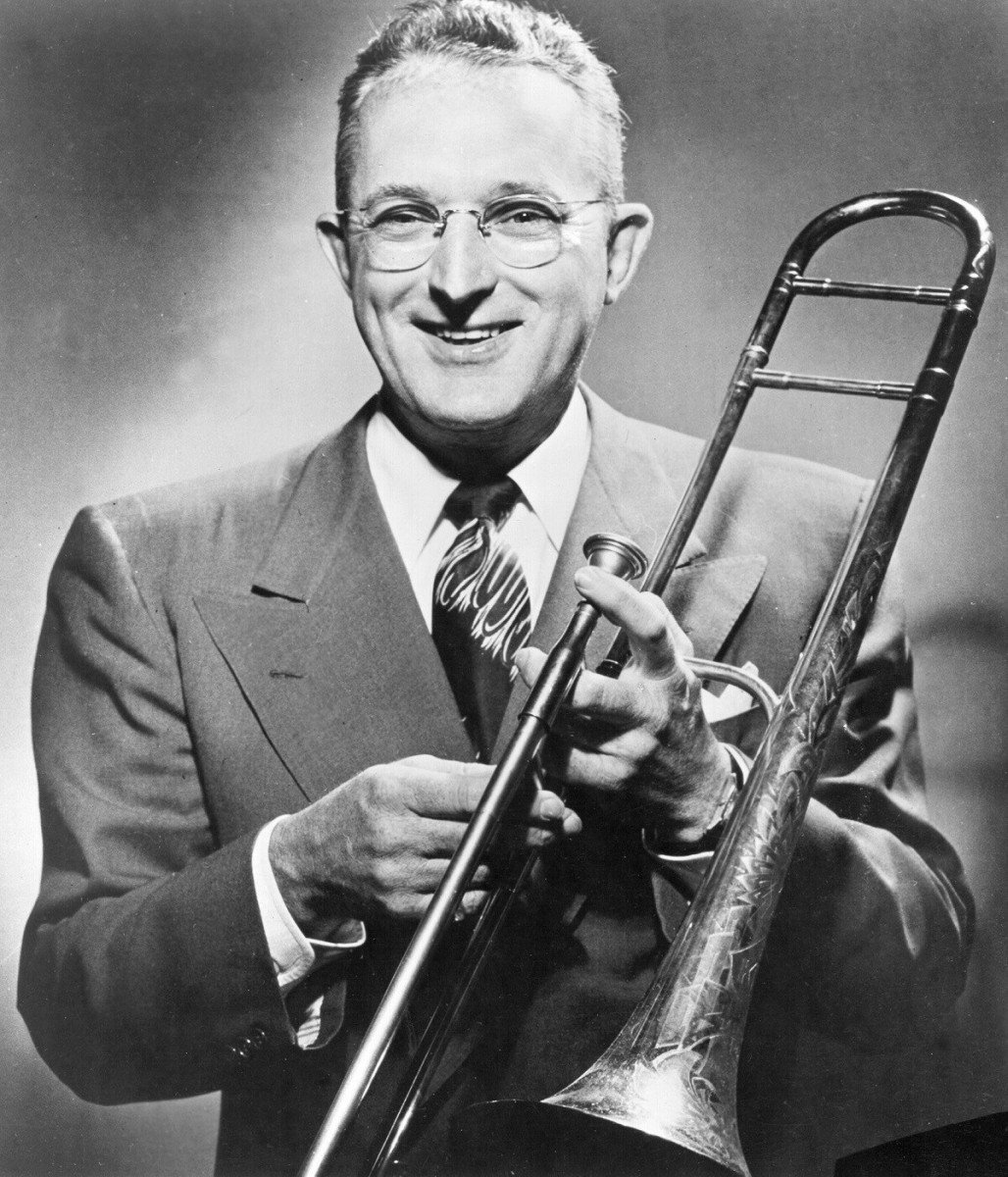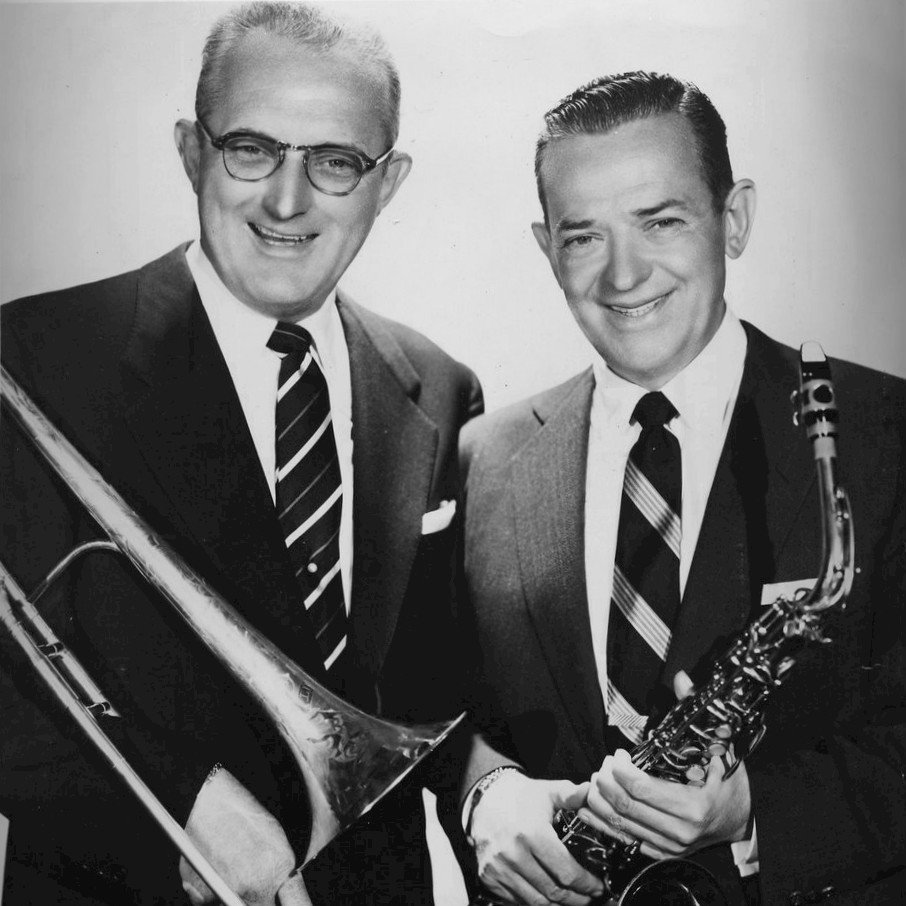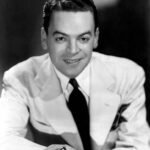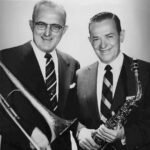
Thomas Francis “Tommy” Dorsey Jr. was born November 19, 1905, in Mahanoy Plane, Pennsylvania, the son of a bandleader who taught him trumpet before he switched permanently to trombone. Alongside his older brother Jimmy, he came up through territory bands of the 1920s—including stints with Jean Goldkette, the California Ramblers, and Paul Whiteman—before the Dorsey Brothers Orchestra scored its first hit, “Coquette,” in 1929. The brothers’ famously combustible partnership finally broke apart on the bandstand in 1935, and Tommy walked out to found his own orchestra. It proved to be one of the defining moves in American popular music: within a few years, Tommy Dorsey’s smooth-toned trombone and sharp business instincts had built the most commercially successful dance band of the swing era, earning him the nickname “The Sentimental Gentleman of Swing.”
By the time Dorsey’s orchestra rolled through Denver, the Trocadero Ballroom at Elitch Gardens had already established itself as “the Summer Home of the Big Band Sound,” and Tommy Dorsey was exactly the kind of marquee attraction owner Arnold Gurtler sought out through his booking connections. Dorsey and his orchestra played the Troc on September 14, 1940—at the absolute peak of the band’s popularity, only months after recording “I’ll Never Smile Again” with a young Frank Sinatra, a record that would spend twelve weeks at No. 1. Denver dancers that night were hearing one of the hottest acts in the country, fresh off arranger Sy Oliver’s overhaul of the band’s sound and squarely in the run of hits that made Dorsey a fixture of American radio and record charts.
Dorsey did not live to see his band’s later Troc engagements. He died in 1956, but his widow, Jane, retained the rights to his name and library of arrangements, and the “Tommy Dorsey Orchestra” continued touring under a series of bandleaders. It was one of these successor bands, fronted by trombonist Warren Covington, that returned to the Trocadero July 15–17, 1959—not long after the Covington-led band had scored a Top Ten, gold-record hit with “Tea for Two Cha-Cha.” The orchestra came back to Denver again on May 26, 1963, with a teenaged Frank Sinatra Jr. making some of his earliest professional appearances as vocalist, and once more that September 5, 1963, under bandleader Sam Donahue. Across these visits, spanning more than two decades, the Tommy Dorsey name repeatedly drew Denver crowds to the Troc’s dance floor—first with Tommy himself at the peak of his powers, and later through the “ghost band” tradition that kept his sound and songbook alive.
Beyond Elitch Gardens, Dorsey’s career amounted to one of the era’s great success stories. He amassed an astonishing 286 Billboard chart hits and seventeen No. 1 records, discovered and launched Frank Sinatra’s solo career, loaned Glenn Miller the money to start his own band, and built a business empire that included music publishing companies and competing Los Angeles ballrooms. He appeared in a dozen Hollywood films, survived a 1949 plane crash without injury, and, in one of the more unlikely footnotes in music history, gave a young Elvis Presley his national television debut on the Dorsey brothers’ Stage Show in January 1956—less than a year before Tommy Dorsey’s own death.
Seasons at the Trocadero
- September 14, 1940 — Tommy Dorsey Orchestra (Tommy Dorsey leading, at the height of the band’s fame, shortly after “I’ll Never Smile Again”)
- July 15–17, 1959 — Tommy Dorsey Orchestra with Warren Covington (posthumous “ghost band,” following the hit “Tea for Two Cha-Cha”)
- May 26, 1963 — Tommy Dorsey Orchestra with Frank Sinatra Jr. (posthumous ghost band)
- September 5, 1963 — Tommy Dorsey Orchestra (under Sam Donahue’s leadership)
Musical Achievements
- Led one of the most commercially dominant orchestras of the swing era, amassing 286 Billboard chart hits.
- Scored seventeen No. 1 hits, including “On Treasure Island,” “Marie,” “The Music Goes ‘Round and Around,” “Once in a While,” “The Dipsy Doodle,” “All the Things You Are,” and his signature smash, “I’ll Never Smile Again” (No. 1 for twelve weeks in 1940, featuring a young Frank Sinatra).
- Discovered and launched Frank Sinatra’s career as a solo star; Sinatra recorded roughly eighty songs with the Dorsey band between 1940 and 1942.
- Hired arranger Sy Oliver away from Jimmie Lunceford’s band in 1939, revitalizing the orchestra’s sound with hits like “Well, Git It” and “Opus One.”
- His band served as a proving ground for major talent, including drummers Buddy Rich and Gene Krupa, arranger Nelson Riddle (later Sinatra’s own celebrated arranger), clarinetist Buddy DeFranco, and singers Jo Stafford, Dick Haymes, and Connie Haines.
- Theme song “I’m Getting Sentimental Over You” became one of the most recognizable signatures of the big band era.
- Appeared in twelve Hollywood films, including Las Vegas Nights (1941), Ship Ahoy (1942), and the semi-biographical The Fabulous Dorseys (1947).
Awards and Honors
- Three of Dorsey’s recordings were inducted into the Grammy Hall of Fame: “I’ll Never Smile Again” (1982), and both “I’m Getting Sentimental Over You” and “Marie” (1998).
- Posthumously inducted into the Grammy Hall of Fame as an artist, an honor reserved for recordings and artists of lasting historical significance.
- Honored on a U.S. Postal Service commemorative postage stamp alongside brother Jimmy Dorsey in 1996.
- His band’s biggest hit, “I’ll Never Smile Again,” is widely regarded as one of the defining recordings of the swing era.
Legacy
Tommy Dorsey’s impact on American popular music outlasted his own lifetime by decades. His launch of Frank Sinatra’s career alone reshaped the trajectory of 20th-century popular singing, and the roster of musicians who passed through his band—Buddy Rich, Gene Krupa, Nelson Riddle, Jo Stafford, and many others—went on to define swing, jazz, and vocal pop for another generation. So enduring was the “Tommy Dorsey Orchestra” brand that it continued touring under successive bandleaders (Warren Covington, Sam Donahue, and later Buddy Morrow) for more than fifty years after Dorsey’s death in 1956, a rare feat in American entertainment.
At the Trocadero Ballroom, Dorsey’s appearances bookended much of the venue’s own golden era. His 1940 date captured the ballroom at the absolute height of the swing craze, when radio station KOA’s broadcasts of “An Evening at the Troc” carried Denver’s dance nights to some thirty states. His band’s return visits in 1959 and 1963—after his death, but still bearing his name and reputation—reflect how deeply the Trocadero’s identity as “the Summer Home of the Big Band Sound” was tied to exactly this kind of marquee national act. Today, as the Historic Elitch Theatre preserves the memory of the Trocadero, Tommy Dorsey’s name remains one of the venue’s most significant historical touchpoints—a direct link between Denver’s dance-hall heyday and one of the true giants of American popular music.
Wikipedia Link: