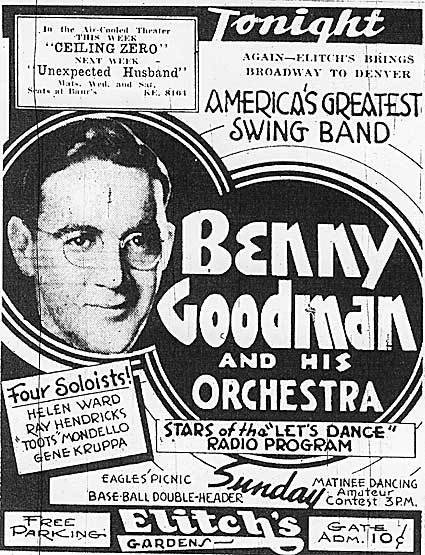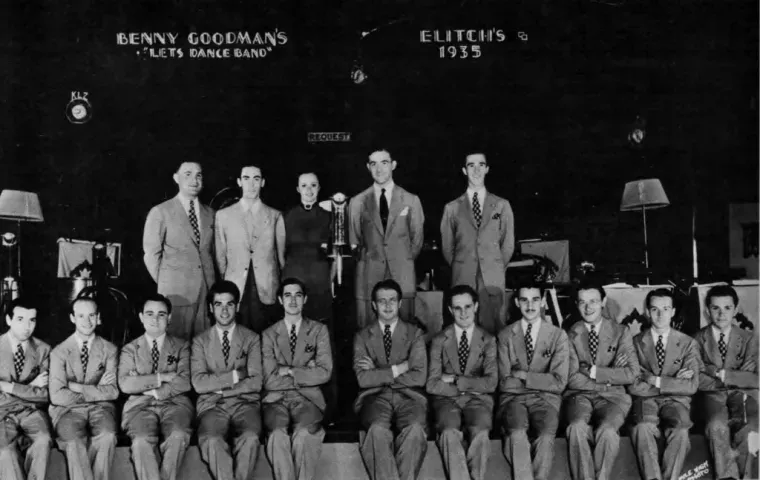
Somewhere in the middle of a cross-country tour that would soon make him the “King of Swing,” Benny Goodman’s orchestra pulled its cars into Denver and set up on the bandstand of the Trocadero Ballroom — Elitch Gardens’ famous dance hall, a horsehair-cushioned floor ringed by stadium seating that had already hosted the biggest touring bands in the country.
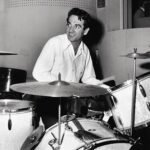
The band opened at the Troc midway through a long summer swing across the Midwest and West. Goodman’s outfit had just picked up trumpeter Bunny Berigan ten days earlier at a one-nighter in Michigan, and the touring lineup that took the Elitch’s stage included Gene Krupa on drums, pianist Jess Stacy, saxophonists Arthur Rollini, Hymie Shertzer, Dick Clark and Bill DePew, trombonists Jack Lacey and Red Ballard, guitarist Allan Reuss, bassist Harry Goodman, trumpeters Ralph Muzzillo and Nate Kazebier alongside Berigan, and vocalists Helen Ward and Joe Harris. Band itineraries from the tour show the engagement was booked to run a full three weeks.
Local Denver lore around the Troc tells a rougher story. According to Denver broadcaster Jack Fitzpatrick, Goodman’s still-new swing sound baffled the Elitch’s dance crowd, and management pulled the plug on the engagement after a single night rather than subject its dancers to more of it. Goodman himself later gave the Rocky Mountain News a blunt account of the stop, admitting the band met an unreceptive crowd more used to waltzes.
“We arrived in Denver and it was a disaster.”
The two accounts don’t fully square with each other — oral history remembers a one-night flop, while the documented tour itinerary has the band booked at the Troc for the entire three weeks before its next stop. Both things can be true in spirit: the crowd’s cool reception on opening night became the story that stuck, even if the contracted run played out. Either way, Elitch’s Trocadero audience was not ready for what Goodman was selling in the summer of 1935.
Denver was one stop in a string of dispiriting houses that summer. From the Troc, the band moved on:
- Aug 16, 1935 Grand Junction, Colorado
- Aug 17, 1935 Cocoanut Grove Ballroom, Salt Lake City, Utah
- Aug 21, 1935 Palomar Ballroom, Los Angeles — the band finally cuts loose with its hottest Fletcher Henderson charts, and a crowd of young dancers roars back
That night at the Palomar is the one jazz history remembers as the true beginning of the Swing Era. Elitch’s, by contrast, is remembered as one of the tour’s rougher nights — a Denver crowd that, according to the Trocadero’s own historians, simply wasn’t ready for what was coming.
Photo: Benny Goodman’s Orchestra, Elitch’s Gardens, 1935 — Duncan P. Schiedt Photograph Collection, National Museum of American History, Archives Center, Smithsonian Institution.
Sources: Colorado Music Experience, “The Trocadero Ballroom at Elitch Gardens”; Historic Elitch Theatre, “The Trocadero Ballroom”; Swing & Beyond, “Jingle Bells (1935) Benny Goodman with Bunny Berigan” and “Good-Bye (1935).”
Seasons at the Trocadero
- 1935
Musical Achievements
- Led one of the most popular big bands of the swing era in the 1930s and ’40s
- His January 16, 1938 concert at Carnegie Hall is often cited as the moment jazz gained mainstream acceptance as a serious art form — it was the first jazz concert ever held there
- Broke racial barriers by leading one of the first racially integrated jazz groups to perform publicly, featuring musicians like pianist Teddy Wilson and vibraphonist Lionel Hampton
- Helped popularize swing music nationally, especially after a famous 1935 performance at the Palomar Ballroom in Los Angeles, often marked as the “start” of the swing era
Awards and Honors
- Multiple Grammy Awards, including a Grammy Lifetime Achievement Award (1986)
- Kennedy Center Honors (1982), recognizing lifetime contributions to American culture through the performing arts
- Inducted into the Grammy Hall of Fame for several recordings
- Recipient of honorary doctorates from several universities (including Columbia and Yale)
- Downbeat magazine polls repeatedly named him top clarinetist for years
Legacy
- Considered one of the most influential clarinetists in American music history
- His band served as a training ground for many musicians who went on to become jazz legends in their own right (Gene Krupa, Harry James, Lionel Hampton, and others passed through his ranks)
Wikipedia Link: