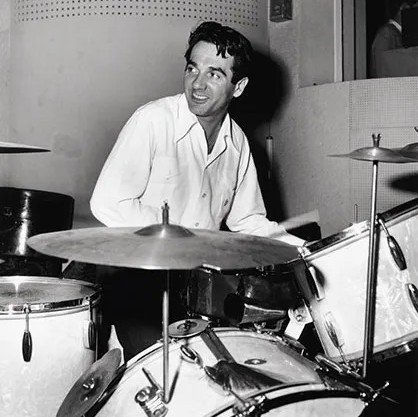
Gene Krupa did more than become one of the most famous drummers of the swing era—he transformed the public image of the drummer. Born Eugene Bertram Krupa in Chicago on January 15, 1909, he began performing professionally during the 1920s and recorded with musicians associated with the emerging Chicago jazz movement. His career accelerated after he joined Benny Goodman’s orchestra in 1934. With his dynamic playing, expressive showmanship, and commanding presence behind the drum kit, Krupa became a featured attraction rather than an anonymous rhythm-section musician. Smithsonian jazz historians have described him as the first true star drummer, crediting him with helping move percussion from a primarily timekeeping role into the musical spotlight.
Krupa’s connection to the Trocadero Ballroom is documented by a surviving 1935 admission ticket preserved by History Colorado. The ticket advertised “Gene Krupa and His Orchestra” at the Elitch Gardens Trocadero on Saturday, September 13, with admission priced at $1.50. This unusually tangible artifact places Krupa at the Trocadero during the formative period of his national fame, when the ballroom was establishing itself as one of Denver’s premier destinations for touring dance orchestras.
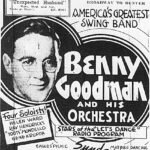
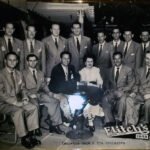
The 1935 engagement came during Krupa’s celebrated association with Benny Goodman. Photographic documentation also places Goodman’s orchestra—including Krupa—at the Trocadero during the summer of that year. The ensemble was then traveling west on the tour that would soon help ignite the national swing craze. Krupa’s forceful drumming was essential to the Goodman sound, particularly in performances that allowed him to build excitement through extended breaks, tom-tom figures, and dramatic rhythmic crescendos. The Trocadero’s large dance floor and enthusiastic audiences would have provided an ideal setting for the energetic performance style that was making Krupa one of the most recognizable instrumentalists in American popular music.
Krupa’s reputation reached a new level with Goodman’s performance of “Sing, Sing, Sing” at Carnegie Hall on January 16, 1938. His driving beat and extended percussion passages became highlights of the concert and demonstrated that a drummer could sustain the dramatic center of a big-band performance. Krupa left Goodman later in 1938 to lead his own orchestra, which became particularly successful during the 1940s. Among the musicians and vocalists associated with his band were trumpeter Roy Eldridge and singer Anita O’Day. Recordings such as “Drum Boogie,” “Let Me Off Uptown,” “Boogie Blues,” and “After You’ve Gone” further established his orchestra as one of the era’s most exciting jazz organizations.
In later years, Krupa worked in smaller ensembles, appeared in Jazz at the Philharmonic concerts, performed celebrated “drum battles” with Buddy Rich, and continued recording and touring into the early 1970s. He also appeared in motion pictures, including The Glenn Miller Story and The Benny Goodman Story, while Sal Mineo portrayed him in the 1959 biographical film The Gene Krupa Story. Krupa died on October 16, 1973, but his influence continued far beyond the swing era. Jazz, rock, and popular drummers inherited not only his techniques but also his fundamental idea that the drummer could be a band’s visual and musical star.
Seasons at the Trocadero
- September 13, 1935 — Gene Krupa and His Orchestra. A surviving admission ticket in the History Colorado collection documents the engagement at the Elitch Gardens Trocadero Ballroom.
- Krupa also appeared at the Trocadero during Benny Goodman’s 1935 western tour. A period photograph identifies Goodman, Krupa, Helen Ward, Bunny Berigan, Jess Stacy, and other orchestra members at the ballroom during the summer of 1935.
Musical Achievements
- Rose to national fame as a member of Benny Goodman’s orchestra and the racially integrated Benny Goodman Quartet.
- Delivered the celebrated drum performance on Goodman’s “Sing, Sing, Sing,” including the landmark 1938 Carnegie Hall concert rendition.
- Formed and led one of the swing era’s best-known orchestras beginning in 1938.
- Featured major jazz artists including Roy Eldridge, Anita O’Day, Charlie Ventura, and Buddy DeFranco.
- Popularized recordings and compositions including “Drum Boogie,” “Let Me Off Uptown,” “Boogie Blues,” “Disc Jockey Jump,” and “Krupa’s Wail.”
- Recorded acclaimed drum-battle performances and albums with Buddy Rich.
- Worked with instrument manufacturers to influence the design and terminology of the modern drum set, including tunable tom-toms and standardized ride, crash, and splash cymbals.
Awards and Honors
- Modern Drummer Hall of Fame, 1979: Krupa was the inaugural inductee in the magazine’s Hall of Fame.
- Grammy Hall of Fame: Benny Goodman’s recording of “Sing, Sing, Sing,” featuring Krupa’s landmark drumming, was inducted in 1982.
- National Recording Registry: The recording of Benny Goodman’s 1938 Carnegie Hall concert was selected for preservation by the Library of Congress in 2003. Krupa’s performance was a major component of the historic concert.
- Smithsonian Institution: A Slingerland drum set associated with Krupa is preserved in the collection of the Smithsonian’s National Museum of American History.
- National Film Registry: Ball of Fire, featuring an energetic musical appearance by Krupa, was added to the National Film Registry in 2016.
Legacy
Gene Krupa is remembered as one of the founding figures of modern drum-set performance. Although earlier jazz drummers had demonstrated great technical and musical skill, Krupa brought unprecedented visibility to the instrument. His performances showed audiences that a drummer could lead an arrangement, command the stage, and attract listeners through personality as well as musicianship.
His collaborations with drum and cymbal manufacturers also helped establish features that became standard components of the modern drum kit. Tunable tom-toms, prominently arranged cymbals, and the familiar terminology of ride, crash, and splash cymbals were all advanced through his influence and advocacy.
Krupa inspired generations of performers across jazz, rhythm and blues, and rock music. Buddy Rich, Max Roach, Louie Bellson, John Bonham, Peter Criss, and countless others followed the path he helped establish. His appearance at the Trocadero Ballroom linked Elitch Gardens directly to a pivotal moment in American music—the emergence of the drummer as a featured star and the rise of swing as a national phenomenon.
Wikipedia Link: