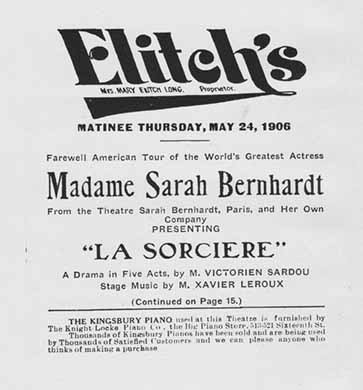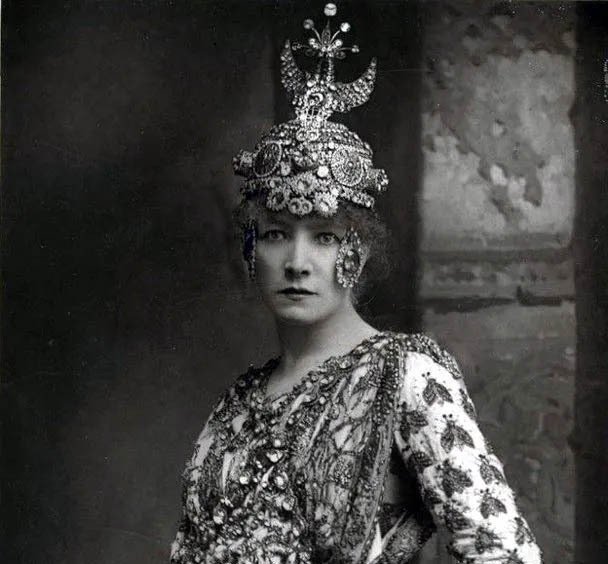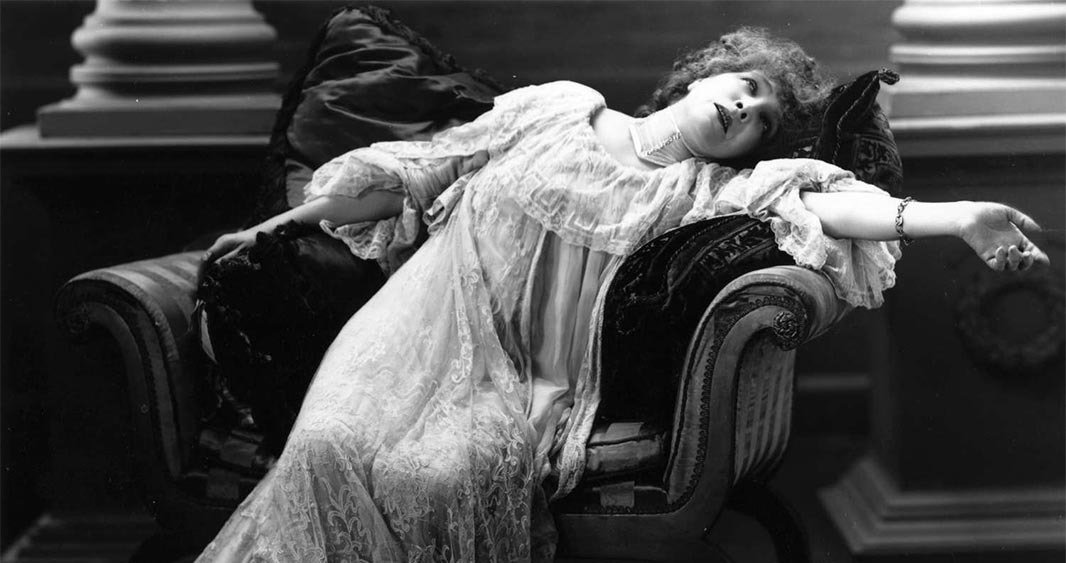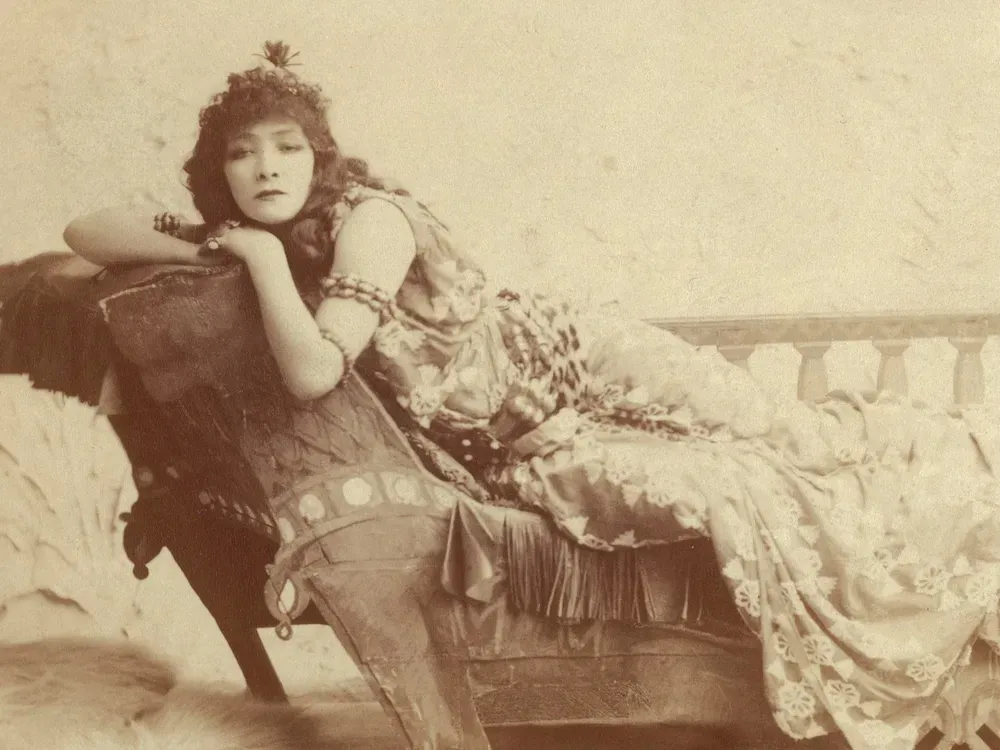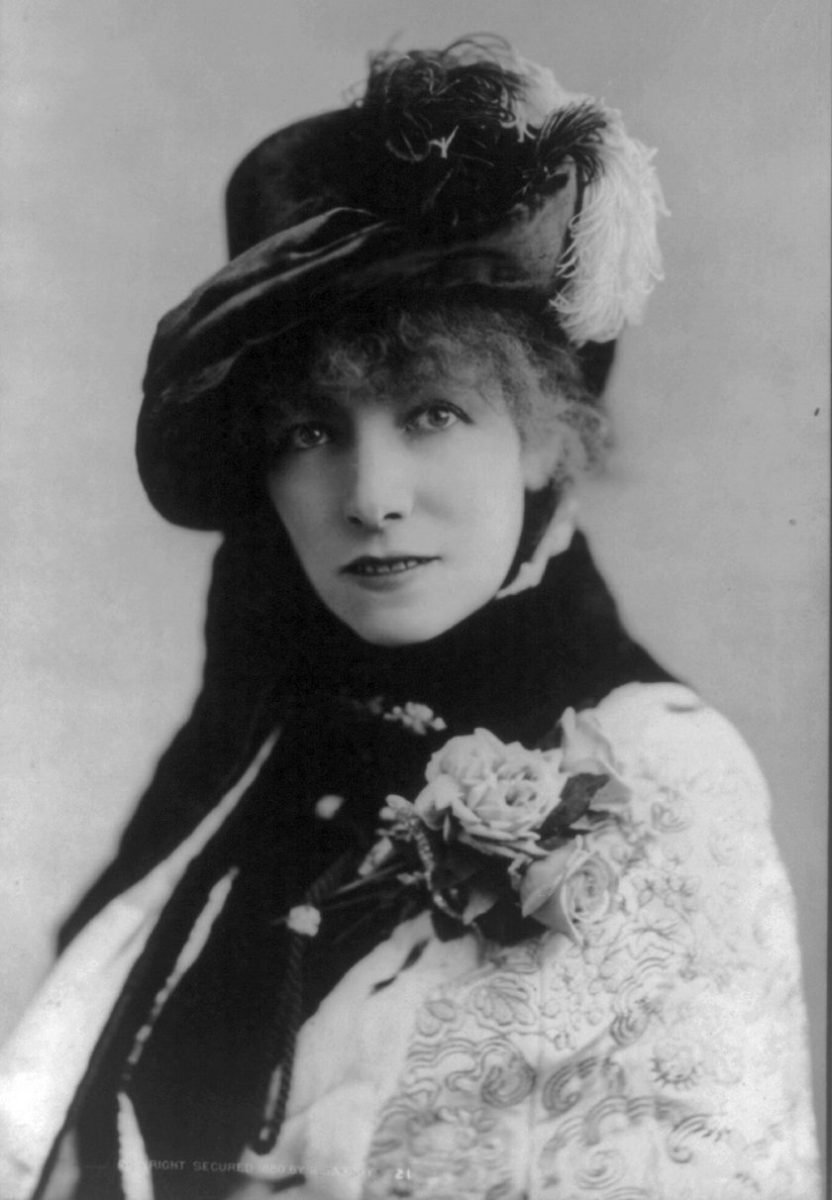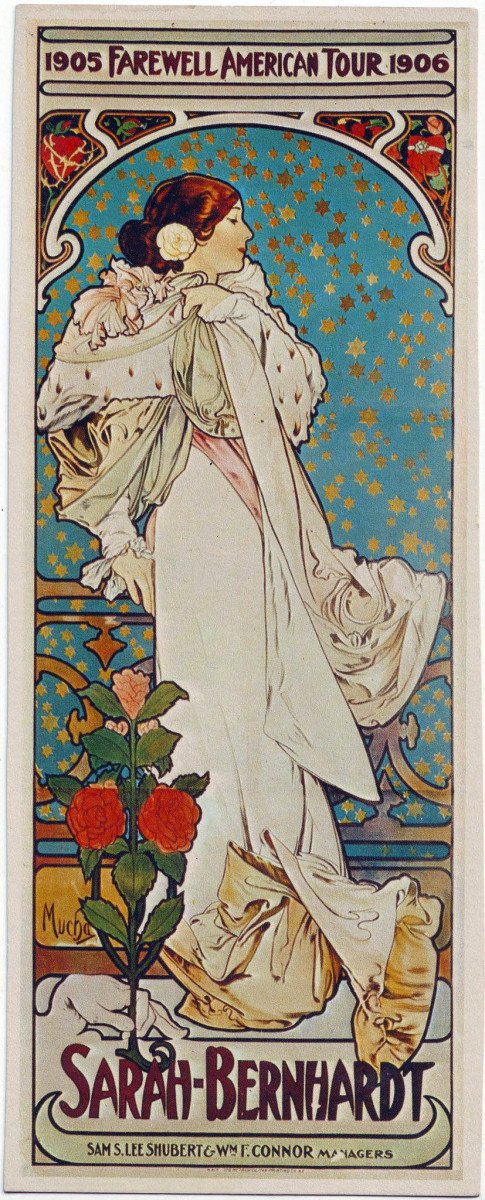
Sarah Bernhardt has been called one of the finest actors of all time, and for one day in 1906 she performed at the Elitch Theater. She had been scheduled to appear in San Francisco, but due to the earthquake, her stop there was canceled and she passed through Denver instead. She did a matinee of La Sorciere and an evening performance of Le Dame aux Camelias.
There are five kinds of actresses: bad actresses, fair actresses, good actresses, great actresses, and Sarah Bernhardt. — Mark Twain
Sarah Bernhardt (1844–1923) was the most famous stage actress in the world for the better part of half a century, and she remains one of the most significant figures in the history of theatre. In 1879 she toured London and ignited an international fame that never dimmed. She went on to form her own touring company in 1880 and later managed her own Paris theatres, including the Théâtre de la Renaissance and the house she renamed the Théâtre Sarah Bernhardt (today the Théâtre de la Ville). Audiences and critics of the era considered her without peer.
On May 24, 1906, Denver had the extraordinary fortune of hosting “the Divine Sarah” at Elitch Gardens Theatre — a stop added to her farewell American tour only because the San Francisco earthquake of that April had forced the cancellation of her scheduled engagement there. In a single day at Elitch, Bernhardt gave a matinee performance of Victorien Sardou’s La Sorcière and an evening performance of La Dame aux Camélias (better known to American audiences as Camille), the role most closely identified with her across her entire career. She played Marguerite Gautier alongside her own touring company, including M. DeNeubourg as Armand Duval. It remains, to this day, the single largest star to have ever graced the Elitch stage.
The Denver Post‘s coverage the next morning captured the reverence Bernhardt commanded even in her sixties. Reviewers marveled that her voice remained, in their words, a “physical wonder,” praising a performance “full of intellectual power, brilliant coloring and quiet eloquence,” and noting that nothing in her acting was ever “small, deformed, fragmentary or spasmodic.” The matinee performance of Camille was singled out for its naturalism, described as being staged with such intimacy that it was “as if a room with the fourth wall knocked out” had been forcibly recalled to the stage.
Beyond her unforgettable day in Denver, Bernhardt’s career reads as a catalogue of theatrical firsts and highlights. She originated some of the era’s most celebrated roles, starred in Victor Hugo’s Ruy Blas, Sardou’s Fédora and La Tosca, and Edmond Rostand’s L’Aiglon (in which, at 55, she played a dying 21-year-old prince), and was among the first women to play Hamlet, appearing in the role in both Paris and London in 1899. She was also a sculptor and painter of real accomplishment, exhibited at the Paris Salon, and one of the first great stage stars to build a global “celebrity” persona — one historians now compare to that of modern pop icons. Even after a knee injury sustained on tour in 1905 led to a leg amputation in 1915, she refused to stop performing, touring French military hospitals and trenches during World War I and continuing to act, seated, for the rest of her life. In 1914 the French government finally inducted her into the Legion of Honour — a recognition long overdue for a woman once denied it by the era’s moral gatekeepers.
In her biography, Mary Elitch tells the story of Bernhardt’s visit to the lion’s den where she began to stroke the head of a lioness. While the lioness sat calmly, Bernhardt asked Mary the name of the lion. When Mary said she hadn’t been named yet, Bernhardt turned to the lioness and said, ‘You are Sarah Bernhardt.’
In the 19th and early 20th century, everyone worshiped at the altar of Sarah Bernhardt. She was a stage actress at a time when the theater was the equivalent of a stadium, a global celebrity who ushered in the very concept. The fanaticism surrounding her was comparable to that inspired by the Beatles or Taylor Swift; her devotees made shrines and gathered below her hotel window; reporters tracked her movements like proto-paparazzi….
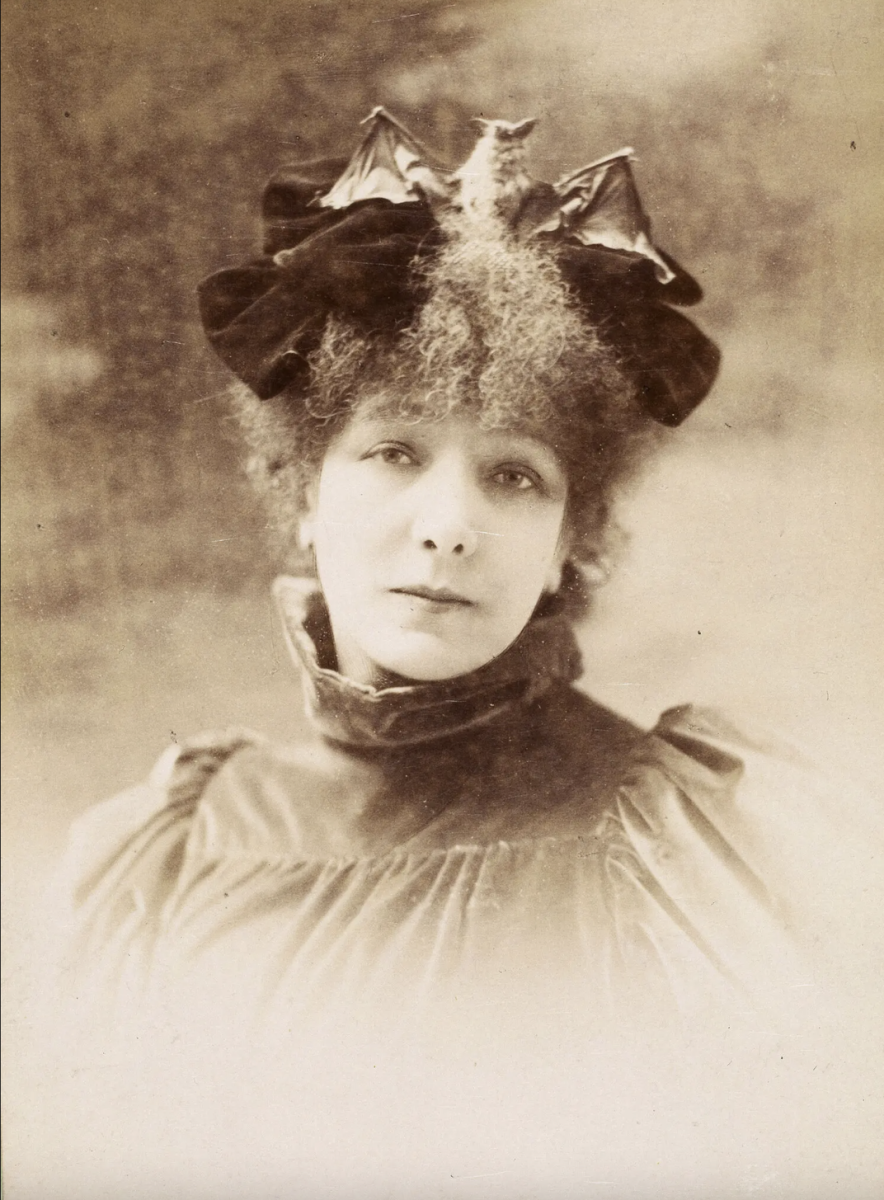
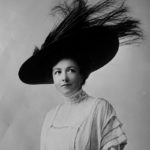
Known for her over-the-top death scenes, Bernhardt had a flair for melodrama, and in her private life, too, she was eccentric with a taste for the macabre. One of her many hats was adorned with a taxidermized bat and she had a photograph taken of herself in a coffin playing dead.
Loayza, Beatrice “Before Taylor Swift or David Bowie, There Was Sarah Bernhardt.” The New York Times, May 11, 2023.
Denver Post coverage of Bernhardt’s Visit:
It would be regarded as something of an impertinence to criticize her. She is unquestionably at the very pinnacle of her art. She makes you feel and fully recognize that fact.
And when she spoke her voice was soft and low, singularly sweet and tremulous with the vibrant quality of young womanhood. It was one of the marvels of the night, for, through the whole play, that gentle, musical, velvety vocalism was an exquisite delight. There was not a strident tone from beginning to end, and when we think of the years that have passed for this gifted creature, does not her voice become a physical wonder?
She gave a performance full of intellectual power, brilliant coloring and quiet eloquence.
The assimilation of the intellectual and emotional was strikingly exemplified in last evening’s performance. It is this quality that has always elevated Bernhardt’s acting from mere imitation to the actual representation of life and its passions.
Denver Post, May 25, 1906
Seasons at the Theatre
- 1906 (single-day engagement, May 24)
Productions/Roles:
- La Sorcière (Zoraya, the Moorish sorceress) — matinee, May 24, 1906
- La Dame aux Camélias (“Camille”) as Marguerite Gautier — evening performance, May 24, 1906
Notable Roles, Awards, and Other Work:
- One of the first women to play the title role in Shakespeare’s Hamlet (Paris and London, 1899)
- In 1906–1907, the French government finally awarded Bernhardt the Legion d’Honneur, but only in her role as a theatre director, not as an actress. However, the award at that time required a review of the recipients’ moral standards, and Bernhardt’s behavior was still considered scandalous. Bernhardt ignored the snub and continued to play both inoffensive and controversial characters.
- Accomplished sculptor and painter who exhibited at the Paris Salon; also wrote poetry, plays, and published memoirs
- Inducted into the French Legion of Honour in 1914, after having been denied full recognition in 1906–1907 on grounds of “moral standing”
- Continued performing after a 1915 leg amputation, including tours to entertain French troops during World War I
- Widely regarded as one of the first global stage celebrities, with a level of public fascination historians have compared to that surrounding modern-day icons
Wikipedia Link: