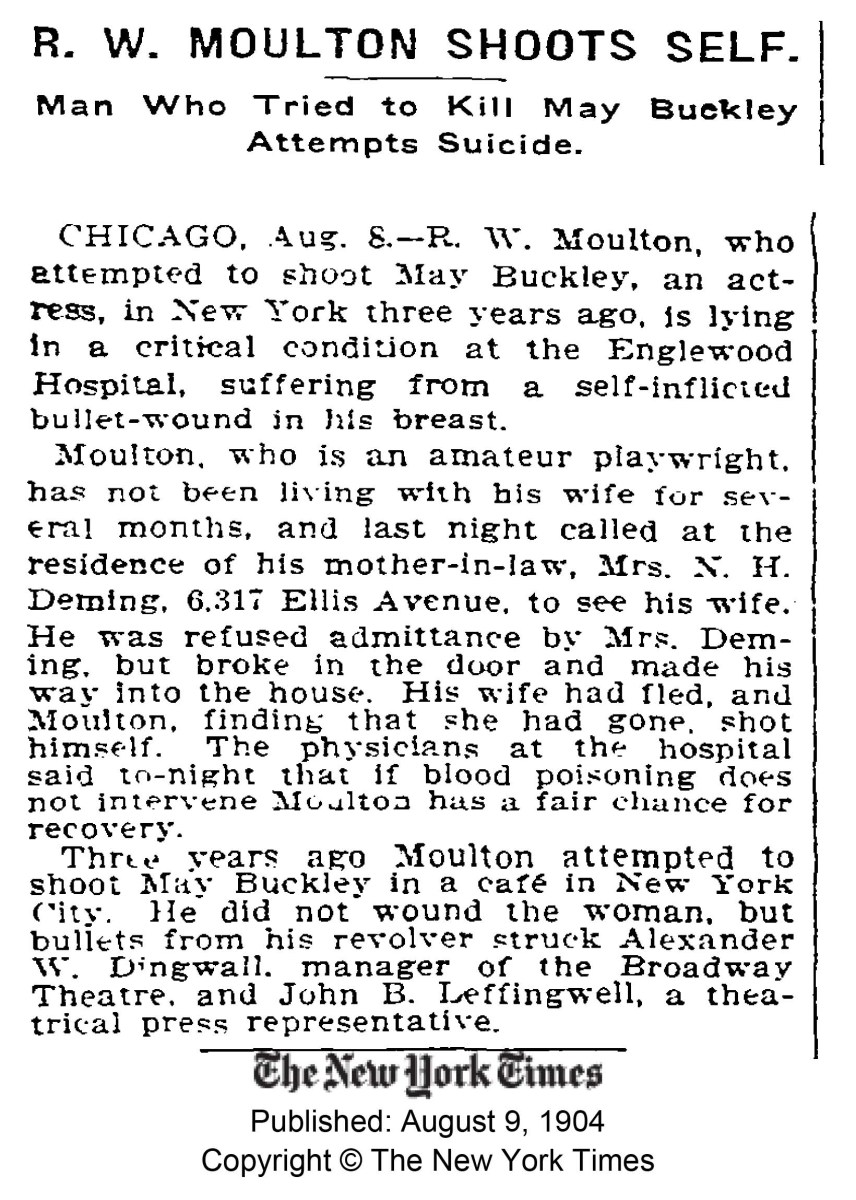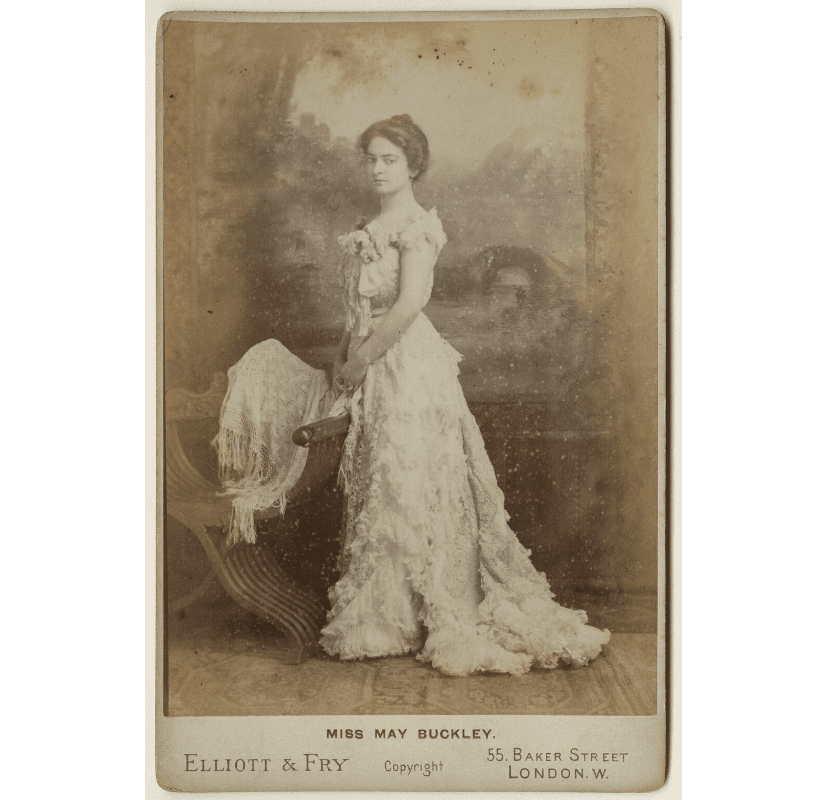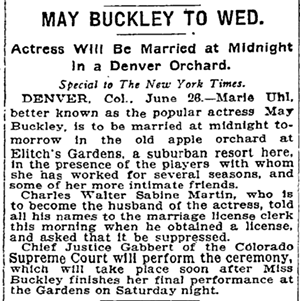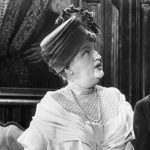
May Buckley’s private life was often in newspaper headlines, especially in 1901, when a man who claimed to be her husband shot at her in a hotel dining room, wounding one of her dining companions. (See the article below — the man is described as a ‘hopeless mental wreck.”)
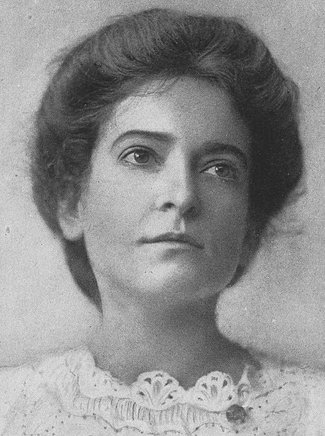
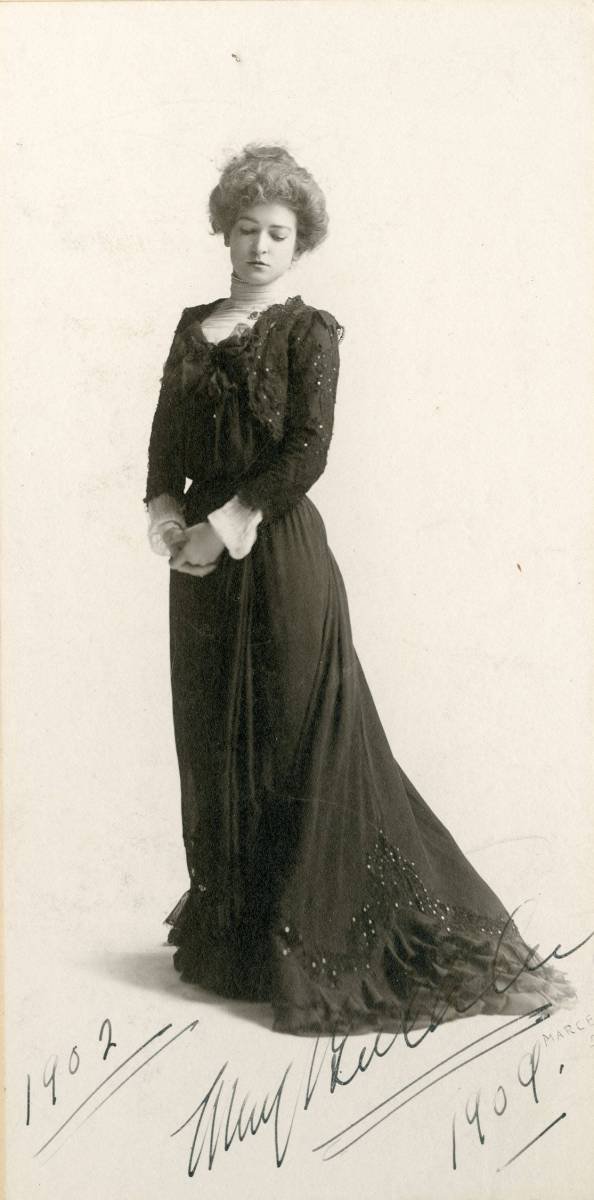
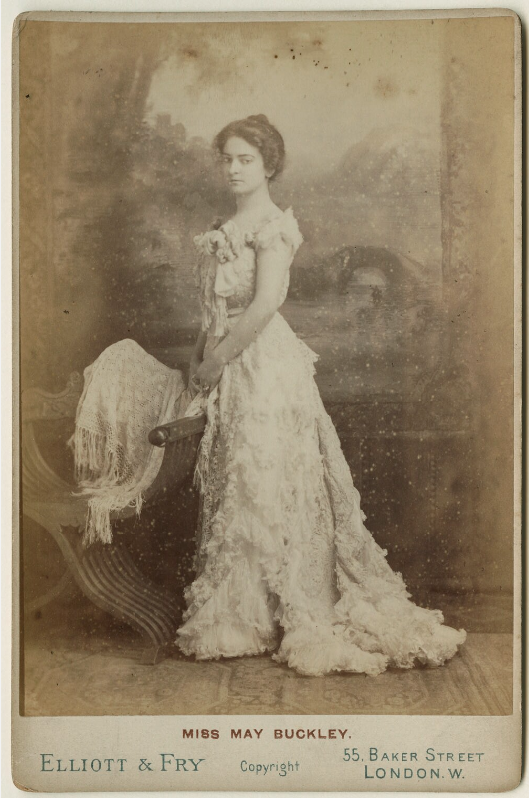
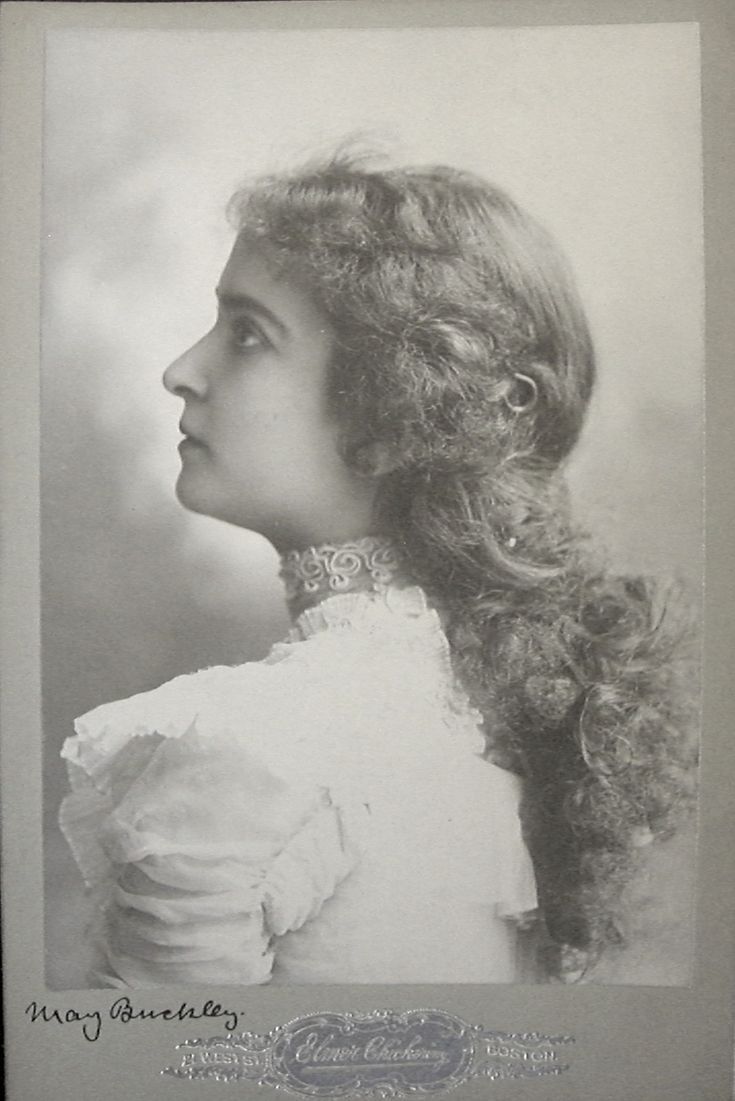
May Buckley — born Marie Uhl in San Francisco in 1875 — was one of the most celebrated leading ladies of the American stage during the first decades of the twentieth century, with a career that stretched from childhood performances in the 1890s all the way to Broadway engagements in the late 1930s. As a child actor, she was given her stage name by family friend Dion Boucicault, the celebrated Irish-born playwright and actor, and she carried the name “May Buckley” through a career that took her from Broadway to London’s West End and, eventually, to the boards of the Elitch Theatre in Denver.
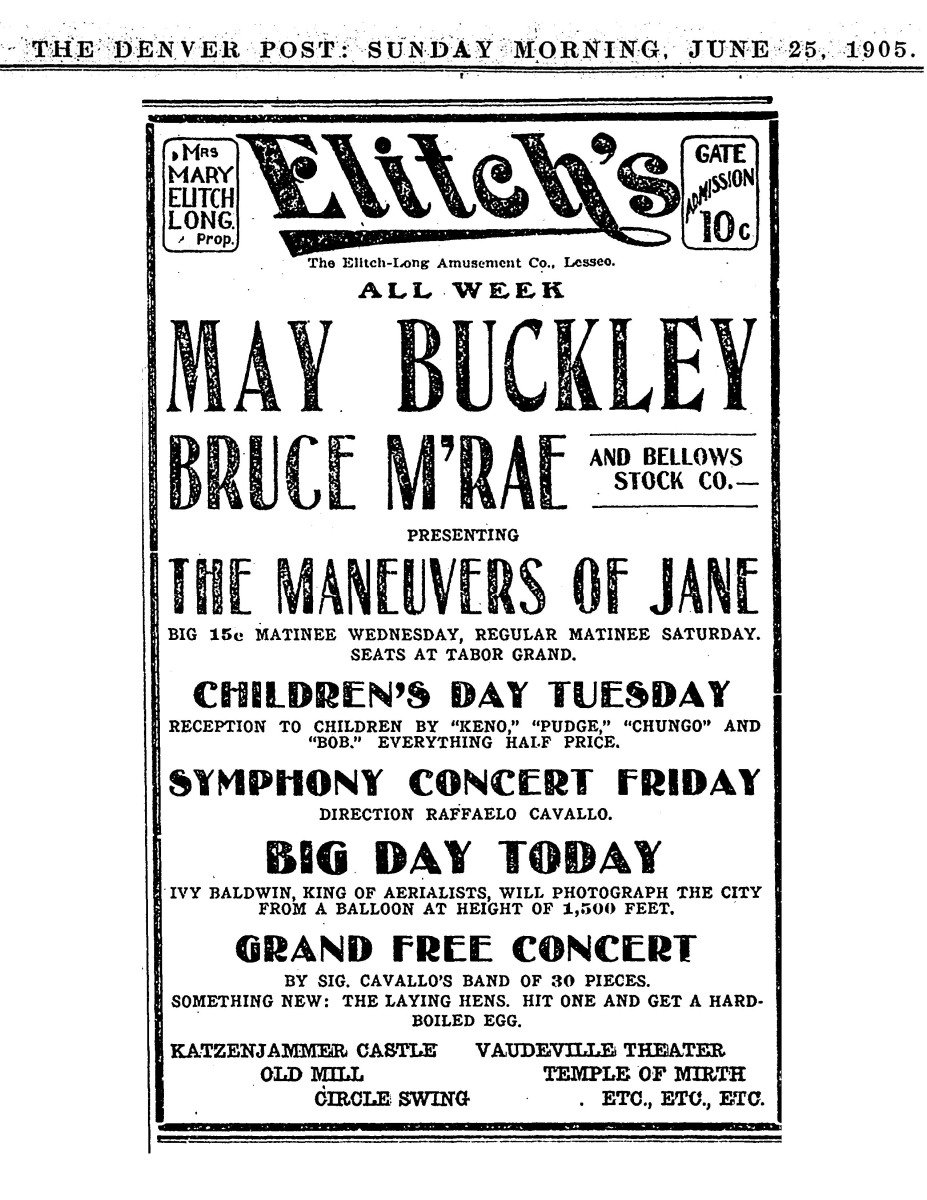
Buckley made her first appearances at Elitch’s in 1904, quickly becoming one of the company’s most popular leading ladies. She opened that season in David Belasco’s The Girl of the Golden West, playing frontier tavern-keeper Minnie Falconer — a role she was said to have played favorably alongside comparisons to Blanche Bates, who had originated the part on Broadway. She returned to Denver for the 1905 and 1906 seasons, sharing the stage with leading man Bruce McRae in productions such as Pretty Peggy, alongside a company roster that, in those same summers, included a young Cecil B. DeMille, Ernest Truex, Theodore Roberts, Maude Fealy, and Tyrone Power. In 1906 she starred in A Japanese Nightingale during the same celebrated season that brought Sarah Bernhardt to the Elitch stage.
Buckley’s fourth and most famous Denver season came in 1908, and it made theatrical history of a different kind. While creating the role of Rosalie in The Right of Way the winter before, she had fallen in love with an English actor in the company, Charles Walter Martin-Sabine. “It was a case of love at first sight,” Miss Buckley assured a friend to whom she opened her heart and announced that Mr. Sabine was coming to Denver to claim her in marriage. There was to be a honeymoon of two weeks in the mountains, then a visit to San Francisco and back to New York. The announcement resulted in concerns to the Elitch management as to the impact it would have on the future plays of the season in which she was to appear. [Borrillo, p. 81]
On June 27, 1908, just after the final curtain of that night’s performance, the couple — May Buckley and Charles Walter Martin-Sabine — were married beneath the trees of Elitch Gardens by a Colorado Supreme Court Justice, with a reception held on the theatre’s own stage before the pair departed for a mountain honeymoon — a wedding theatre proprietor Mary Elitch Long herself later recalled fondly in her memoirs.
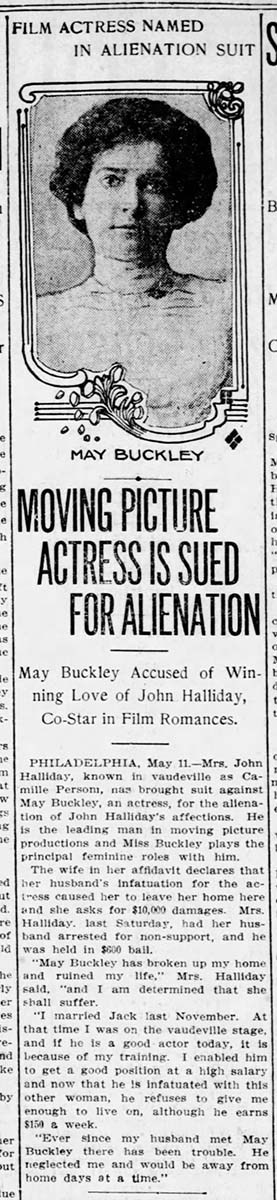
BUT, the drama continued… In 1912, Buckley was sued for alienation of affections by John Halliday‘s wife, Camille Personi. “‘May Buckley has broken up my home and ruined my life,’ Mrs. Halliday said, ‘and I am determined that she shall suffer.’”
In 1927, Buckley returned to Elitch’s one final time, appearing in the farce The Cradle Snatchers alongside a young stock-company actor billed simply as “March” — the future two-time Academy Award winner Fredric March — in what was remembered as one of the most successful seasons in the theatre’s history.
Seasons at the Theatre
Elitch Theatre Productions/Roles:
- 1904 — The Girl of the Golden West (David Belasco) — as Minnie Falconer
- 1905 — Pretty Peggy, leading lady opposite Bruce McRae
- 1906 — A Japanese Nightingale
- 1908 — Company member; season included The Right of Way rehearsal period (winter prior) and her on-stage Elitch Gardens wedding following a performance
- 1927 — The Cradle Snatchers (Russell Medcraft & Norma Mitchell) — as one of the three matrons, alongside Kirby Davis and Florence Rittenhouse
Notable Roles, Awards, and Other Work:
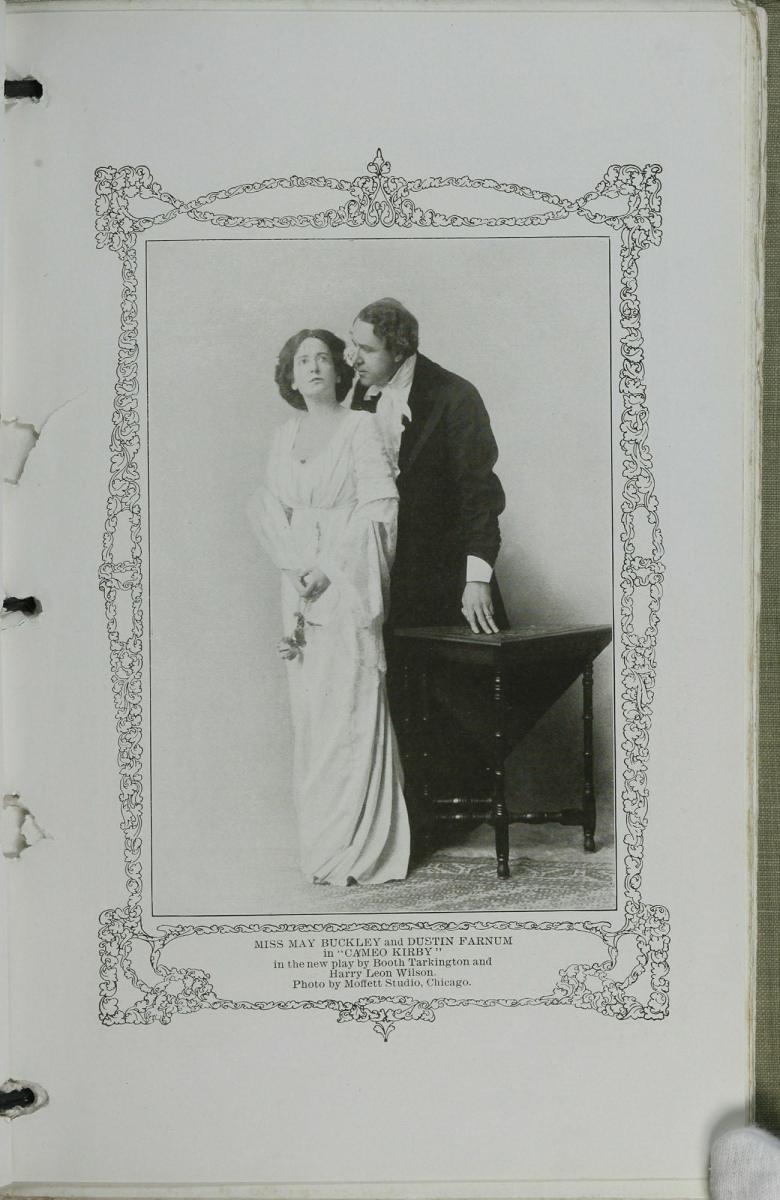
- Extensive Broadway career, including Hearts Are Trumps (1900), Caleb West (1900), The Price of Peace (1901), A Japanese Nightingale (1903), The Shepherd King (1904), The Galloper (1906), The Right of Way (1907), Cameo Kirby (1909–1910), Where There’s a Will (1910), The Little Damozel (1910), The Unwritten Law (1913), Pigs (1924–1925), These Days (1928), and Tell Me Pretty Maiden (1937–1938)
- Appeared on the London stage
- Starred in more than twenty silent short films for the Lubin and Selig companies (1912–1913), including Paid in His Own Coin, Betty and the Doctor, Hello, Central!, and Miss “Arabian Nights”
- Co-founder/organizer of the Stage Women’s War Relief Association during World War I, raising funds for a disabled soldiers’ home
- Active member of the Catholic Actors’ Guild of America in the 1920s and 1930s
Elitch Theatre Connections:
- May’s father’s friend, actor and playwright Dion Boucicault, gave her the stage name “May Buckley” when she was a child actor. Boucicault’s son, Aubrey Boucicault, would be the leading may for the Elitch Theatre summer season in 1903.
- Bruce McRae — fellow HET alum and her leading man during the 1905 Elitch season, co-starring in Pretty Peggy
- Fredric March — the future two-time Academy Award-winning actor appeared onstage with Buckley in The Cradle Snatchers during the 1927 Elitch season, early in his stock-company career
- Cecil B. DeMille, Ernest Truex, Theodore Roberts, Maude Fealy, and Tyrone Power, Sr. — fellow members of the Elitch stock company during Buckley’s 1905 season
Wikipedia Link: