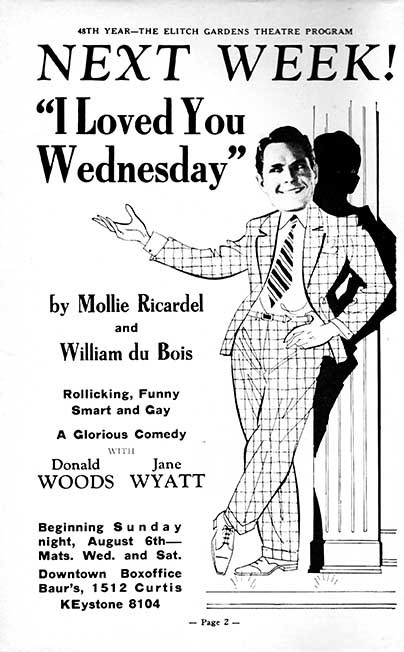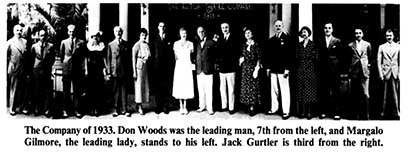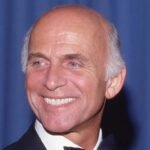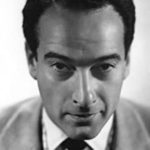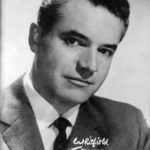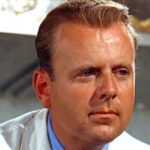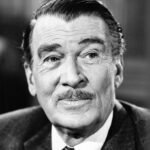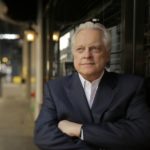
Donald Woods (born Ralph Lewis Zink, December 2, 1906, in Brandon, Manitoba; died March 5, 1998) was a Canadian-American actor whose Hollywood career lasted six decades. He grew up in California, graduated from the University of California, Berkeley, and began his career in West Coast stock theatre before making his film debut in 1928. Like many Elitch alumni, he learned his craft on the stage before moving to the screen.
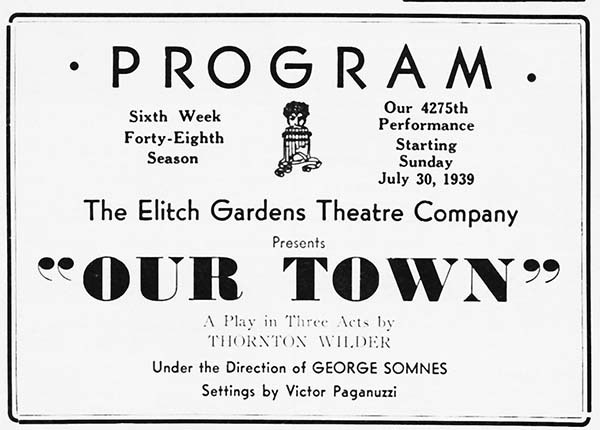
Woods’ ties to Elitch Gardens ran deeper than most. He returned as leading man for several summers between the early 1930s and the late 1940s. Edwin Lewis Levy, whose 1960 doctoral dissertation studied the theatre’s history, wrote that the leading man had to win over an audience that was more than two-thirds women. Levy singled Woods out as “perhaps the most outstanding” of the era’s leading men, a group that included Donald Cook, Kent Smith, Harvey Stephens, Kenneth MacKenna, and Roger Pryor. Woods was attractive and appealing to patrons and also a thoroughly competent actor. Levy said he had all the qualities the job required, with few, if any, liabilities.
Elitch Theatre also gave Woods his big break. In 1933, while he was playing in The Pursuit of Happiness on our stage, a motion picture scout discovered him and he was offered a Hollywood contract. The Golden Jubilee Theatre Program said he “skyrocketed to fame immediately.” Success did not lead him to forget the theatre. When he returned as leading man for the 1941 season, an eleven-week run (one week longer than usual) opposite leading woman Ruth Matteson, the Jubilee program noted his sincere affection for the old stage where his film career began.
On screen, Woods worked steadily as a leading man and character actor. He appeared in dozens of B pictures, including a turn as lawyer Perry Mason in The Case of the Stuttering Bishop (1937). He also played the romantic lead opposite Lupe Velez in the popular Mexican Spitfire comedies. He landed major roles in prestige films such as A Tale of Two Cities and Watch on the Rhine, and later became a familiar face on early television. He retired from acting in 1976 and worked as a successful real estate broker in Palm Springs, California. Fittingly, a later Elitch alum, Raymond Burr, would become the actor most closely identified with Perry Mason.
Seasons at the Theatre
Productions/Roles:
- The Pursuit of Happiness (1933): Woods was appearing in this Elitch Theatre production when he was discovered by a motion picture scout and offered a Hollywood contract.
- 1941 season: Leading man, opposite leading woman Ruth Matteson, in the theatre’s Golden Jubilee season.
- All other seasons: Leading man with the Elitch Gardens Theatre Company.
Notable Roles, Awards, and Other Work:
- A Tale of Two Cities (1935): Played Charles Darnay, the sympathetic French aristocrat, in this major film adaptation of the Dickens novel.
- Anthony Adverse (1936): Played Vincent Nolte in this large-scale feature.
- The Case of the Stuttering Bishop (1937): Played lawyer Perry Mason.
- Mexican Spitfire series (1939–1941): Played Dennis Lindsay, the romantic lead opposite Lupe Velez, in the popular B-comedy series.
- Watch on the Rhine (1943): Played David Farrelly in the film adaptation of Lillian Hellman’s play.
- The Bridge of San Luis Rey (1944) and Roughly Speaking (1945): Played Brother Juniper and Rodney Crane, respectively, in two more feature roles.
- Star in the Night (1945): Played a hitchhiker in this Christmas parable, which won the Academy Award for Best Short Subject. His sensitive performance drew notice.
- Craig Kennedy, Criminologist (1951): Starred in the title role of this syndicated television series.
- Early television host and anthology actor: Hosted CBS’s Damon Runyon Theater and was one of three hosts of ABC’s The Orchid Award. He also appeared in anthology series such as The Philco Television Playhouse, Robert Montgomery Presents, and General Electric Theater.
- Later television and film work: Played John Brent in Tammy and appeared in 13 Ghosts (1960) and True Grit (1969). He made guest appearances on Bonanza, Wagon Train, Ben Casey, The Wild Wild West, and Ironside before retiring in 1976.
Elitch Theatre Connections:
- 1935 — Stranded (Film) — George Brent (HET 1929) and William Harrigan (HET 1929) — Woods played John Wesley, Brent starred as Mack Hale, and Harrigan played Updyke; all three appeared in the same film. AFI Catalog
- 1936 — Road Gang (Film) — Addison Richards (HET 1962) — Woods starred as James “Jim” Larrabie and Richards played Warden Parmenter. AFI Catalog
- 1936 — Anthony Adverse (Film) — Fredric March (HET 1926), Pedro de Cordoba (HET 1913), and Addison Richards (HET 1962) — Woods played Vincent Nolte; March starred as Anthony Adverse, de Cordoba played Brother François, and Richards played Captain Matanaza. AFI Catalog
- 1940 — Quiet, Please! (Broadway Play) — Jane Wyatt (HET 1939) — Woods originated Roland Pierce and Wyatt originated Carol Adams in the short-lived Broadway production at the Guild Theatre. This is particularly notable because the pair had been Elitch leading players the previous year, but this Broadway engagement was entirely outside HET. IBDB
- 1942 — The Gay Sisters (Film) — George Brent (HET 1929) and Gig Young (HET 1973) — Woods played Penn Sutherland Gaylord, Brent played Charles Barclay, and Young appeared as the character “Gig Young,” the role from which he subsequently took his professional name. IMDb
- 1943 — Watch on the Rhine (Film) — Beulah Bondi (HET 1925–26) — Woods played David Farrelly and Bondi played Anise in the Warner Bros. adaptation of Lillian Hellman’s play. IMDb
- 1944 — Hollywood Canteen (Film) — Joe E. Brown (HET 1963) and Kitty Carlisle (HET 1965, 1970) — Woods, Brown, and Carlisle all appeared as themselves in the film’s large collection of Hollywood celebrity appearances. IMDb
- 1946 — Night and Day (Film) — Eve Arden (HET 1965) and Selena Royle (HET 1930) — Woods played Ward Blackburn, Arden played Gabrielle, and Royle played Kate Porter in the Cole Porter biographical musical. AFI Catalog
- 1949 — Daughter of the West (Film) — Pedro de Cordoba (HET 1913) — Woods played Commissioner Ralph C. Connors and de Cordoba played Chief Wykomas in the Western. AFI Catalog
- 1949 — Scene of the Crime (Film) — Van Johnson (HET 1977) and Tom Powers (HET 1925) — Woods played Bob Herkimer; Johnson starred as Mike Conovan and Powers played Umpire Menafoe. AFI Catalog
- 1950 — Johnny One-Eye (Film) — Pat O’Brien (HET 1980) — Woods appeared as the veterinarian while O’Brien starred as Martin Martin. AFI Catalog
- 1960 & 1962 — 77 Sunset Strip (TV Series) — Edd Byrnes (HET 1968) — Woods guest-starred in the episodes “The Duncan Shrine” (1960) and “Jennifer” (1962), while Byrnes was a regular member of the series as Gerald Lloyd “Kookie” Kookson III. This is a same-series television connection rather than a separate film or stage collaboration. TheTVDB
- 1971 — Ironside, “The Gambling Game” (TV) — Raymond Burr (HET 1944) — Woods guest-starred as Dr. Richard Latham directly opposite Burr’s regular character, Robert T. Ironside, in the October 5, 1971 episode. IMDb
Wikipedia Link: