The Denver Post introduced the July 26th, 1908, opening of the play, Raffles., with a lengthy summary of the show:
“Raffles, the Amateur Cracksman,” at Elitch’s
Just the kind of a play to put and keep a summer audience in good humor—bright, witty, audacious, with a fling at conventionality and soupçon of danger—a play to suit the clean-cut personality of Henry Woodruff and the supreme femininity of May Buckley—this is “Raffles, the Amateur Cracksman,” which Mrs. Elitch Long intrusts [sic] to the Bellews stock company tonight to entertain for a week the ever-growing crowds at the Gardens. Kyrle Bellew, E. M. Holland, Clara Blandick and Hattie Russell were among the New York cast, but with Mr. Woodruff, Miss Buckley, Miss Abbott, Mr. Arden, Mr. Cope, Mr. Boehmer, Mr. Elliott and Mr. Lewis it is rather difficult to see where Elitch’s is going to suffer by comparison.
The play is founded upon a series of sketches by E. W. Hornung and Eugene Presbrey. Unlike many plays that have been made from successful books, “Raffles” can be followed and clearly understood by those familiar with the original. The hero and the villain are rolled into one in strange play-fashion. Raffles (or, rather, A. J. Raffles), an Oxford graduate and educated English gentleman, has some strain in his blood which compels him to steal. He does not pilfer for the sake of gain, but does it for the excitement and pleasure of the thing. It is his mania to steal very valuable things that are very hard to get, and then, after enjoying the discomfiture of the police, to return the valuables to their owners, leaving them in a great state of mystification. Raffles is seen in the first act enjoying the hospitality of Lord Ameresmith, who is giving a house party to a number of guests, among them being Captain Bedford, a detective, who makes a specialty of hunting down big game. Bedford has a suspicion that Raffles is the “amateur cracksman” that has fooled Scotland Yard, and the rest of the play is devoted to working out this suspicion and the snaring of Raffles, who, being as keen and ingenious as the detective, leads him a merry chase.
In the first act [sic] Crawshay, a simon-pure burglar, who has an accomplice in a French maid employed at Lord Ameresmith’s, enters through an open window. The maid appears upon a balcony and drops to Crawshay a diamond necklace she has slipped from the throat of one of the guests. Raffles stumbles with him a blow, seizes the necklace, thrusts it into his pocket, raises an alarm, and Crawshay is taken into custody. Bedford, who has partly taken in the situation and draws his own conclusions, He goes to Raffles’ apartments in London and conducts his investigations in a quiet way. He has permitted Crawshay to escape, and, of course, the criminal turns up and has a very lively quarter of an hour with Raffles, demanding his half of the “swag.”
At the end of the play, Raffles, pretending to see that he is cornered, confesses everything, returns the necklace to Lord Ameresmith and darts into an adjoining room. A pistol shot is heard and everybody supposes that Raffles has committed suicide. The doors are flung open and it is found that the clever cracksman has used the pistol as a ruse, and in the excitement has made his escape. The ending is very ingenious and gives the audience a surprise.
There is a love story running through the play, in which Raffles and Gwendolyn Connor are involved, and Gwendolyn is so interested in the villain-hero that she helps him to escape, though she knows him as he really is.
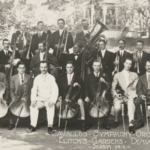
The usual matinees will be given on Wednesday and Saturday, Tuesday, children’s day, is assuming such importance that it is now reckoned the mid-week event of each week. The Gardens can scarcely crowd the ever-growing throngs. The Indian games are especially popular, while the dancing classes conducted by Miss Wallace are as rapturously enjoyed by the young folk as is a university club ball by their elder sisters. Not among the least recognized mid-summer events is the ever widening interest taken in the symphony concerts, the Friday afternoon affairs having now become the social function of each week. Mrs. Bessie Fox Davis will be the week’s soloist.
In outdoor attractions Elitch’s has again taken its old-time lead. Its baseball grounds is the home of the City league and the games played each Sunday are of such superior quality that the attendance would do vast credit to any of the minor associations. The big circus acts also given free each Sunday draw the amusement seeker Elitchward. Today’s feature act is that of the flying Gordons, the California aerialists. The café is open for the summer and the meals served there and under the adjacent fragrant apple trees are drawing luncheon, dinner and theater parties in large numbers. The Teddy bears, the old mill, the toboggan slide and the numerous other attractions of the Elitch gladway [sic] seem to have lost none of their popularity. Today’s baseball game and band concert is scheduled for 3 o’clock, with the free circus at 4:30 and again at 7:30. Seats for all Elitch performances are on sale at the Columbine Floral company, Sixteenth and Champa streets.
[1908-07-26, Denver Post, p42]
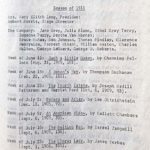
Resident Company:
Productions:
- Week of May 29: The Girl of the Golden West, by David Belasco, featuring May Buckley.
- Week of June 7: La Belle Marseillaise, by Pierre Berton, featuring May Buckley and Holbrook Blinn.
- Special Performances, June 9: (Matinee and Evening)
- Rosmersholm, by Henrik Ibsen, featuring Mrs. Fiske and the Manhattan Company, including Arthur Forrest, Fuller Mellish, Albert Bruning, William A. Norton, and Mary Maddern.
- Week of June 14: Salomy Jane, by Paul Armstrong, featuring May Buckley.
- Week of June 21: The Hypocrites, by Henry Arthur Jones, featuring May Buckley.
- Week of June 28: The Rose of the Rancho, by David Belasco and Richard Walton Tully, featuring Doris Keane.
- Week of July 5: The County Chairman, by George Ade, featuring Doris Keane
- Week of July 12: A Japanese Nightingale, by william Young, featuring May Buckley.
- Week of July 19: Old Heidelberg, by William MeyerFoster, featuring Henry Woodruff and May Buckley.
- Week of July 26: Raffles, by E.W. Hornung and Eugene W. Presbrey, featuring Henry Woodruff and May Buckley.
- Week of Aug. 2: A Royal Family, by Capt. Robert Marshall, featuring Henry Woodruff and May Buckley.
- Week of Aug. 9: As You Like It, by William Shakespeare, featuring Henry Woodruff and May Buckley.
- Week of Aug. 17: The Music Master, by Charles Klein, featuring David Warfield and his company, including Taylor Holmes, Oscar Eagle, Antoinette Perry, and Ruth Gates.
- Week of Aug. 24: A Grand Army Man, by David Belasco, Pauline Phelps, and Marion Short, featuring David Warfield and his company.
- Week of Aug. 31: The Music Master, with David Warfield and his company.
- Post-Season Performances, listed as a Festival of German Drama, presented by the Ferdinand Webb Star Ensemble:
- Sunday Matinee, Sept. 6: Zwei Glueckliche Tage.
- Sunday Evening, Sept. 6: Tante Regina.
- Sunday Matinee, Sept. 13: Mauerbluemchen.
- Sunday Evening, Sept. 13: Anna-Lise