The Three Carousels of Elitch Gardens
For more than a century, a carousel has turned at Elitch Gardens — but not always the same one. Three distinct machines have carried Denver’s children (and more than a few grown-ups) around in circles since the park opened in 1890. Here is their story.
Carousel #1: Steam-Powered
Long before the two celebrated Philadelphia Toboggan Company (PTC) carousels arrived, Elitch’s already had a merry-go-round turning among the flowers and animal cages. Detailed records of this earliest machine are scarce, but a few consistent threads survive.
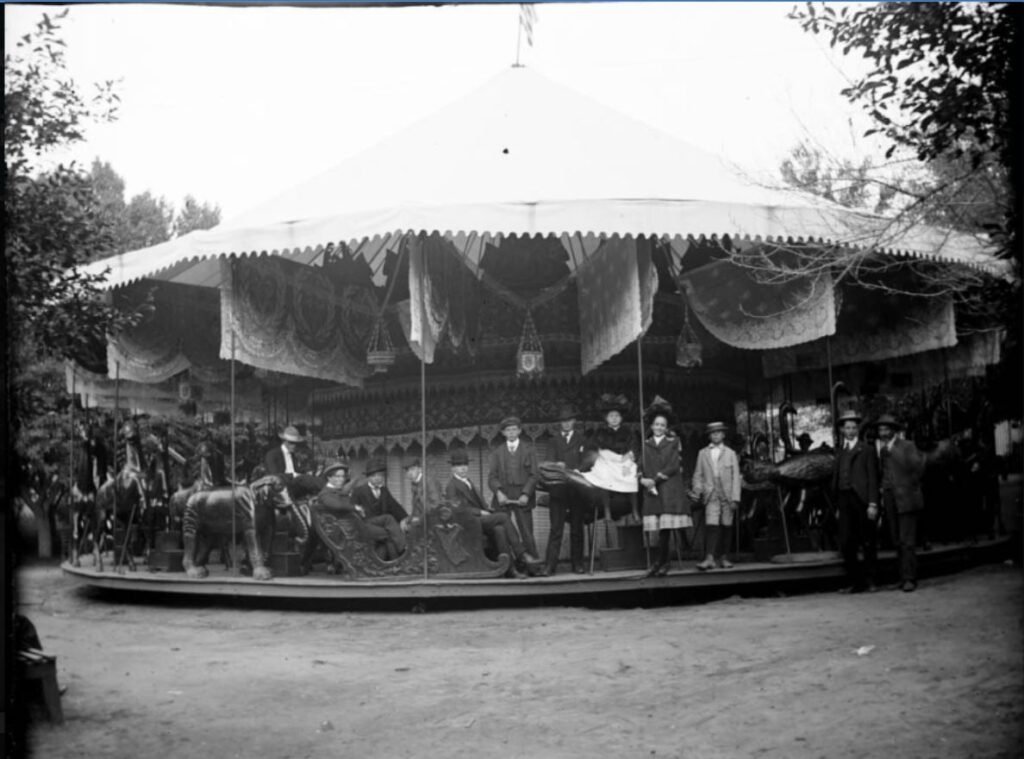
By most accounts, sometime after Elitch’s Zoological Gardens opened on May 1, 1890, Mary Elitch began adding rides and amusements to their botanical park and zoo. Histories of the park describe the addition of “swings, a merry-go-round, and a train” during the gardens’ first decade, and multiple sources specifically describe Elitch’s earliest carousel as a steam-driven merry-go-round — modest compared to what would follow.
The steam carousel’s run came to an end because Mary Elitch wanted something grander. According to the Kit Carson County Carousel’s own history, Mary saw a far more impressive carousel while visiting Manhattan Beach, an amusement park in nearby Sloan’s Lake, and decided Elitch’s needed one just like it. That decision led her to place an order with the young Philadelphia Toboggan Company, and the little steam machine was retired when its replacement arrived in 1905.
In 1905, the Denver Post reported: “The old merry-go-round, which has for years ground out happiness for the children; is no more. In its place a new merry-go-round, three times as large, is now being erected.” [Denver Post, May 8, 1905, p. 6]
Beyond that, the trail goes cold for additional information on the original carousel — no manufacturer and no firm installation date have turned up in the available sources. If any Historic Elitch Theatre archives, park ledgers, or newspaper clippings from the 1890s or early 1900s mention this original steam carousel by name, they would be a valuable addition to this history.
Carousel #2: Philadelphia Toboggan Company #6 (PTC #6) (1905–1927)
In 1905, Elitch Gardens took delivery of the sixth carousel ever built by the Philadelphia Toboggan Company (PTC) — a company still in its infancy, having only opened for business in 1904 after acquiring the E. Joy Morris Company, an established Philadelphia-area carousel maker. The carousel made its public debut in Denver on May 28, 1905; a Rocky Mountain News article from that day noted the care Mary Elitch had taken “to select the best for the children.”
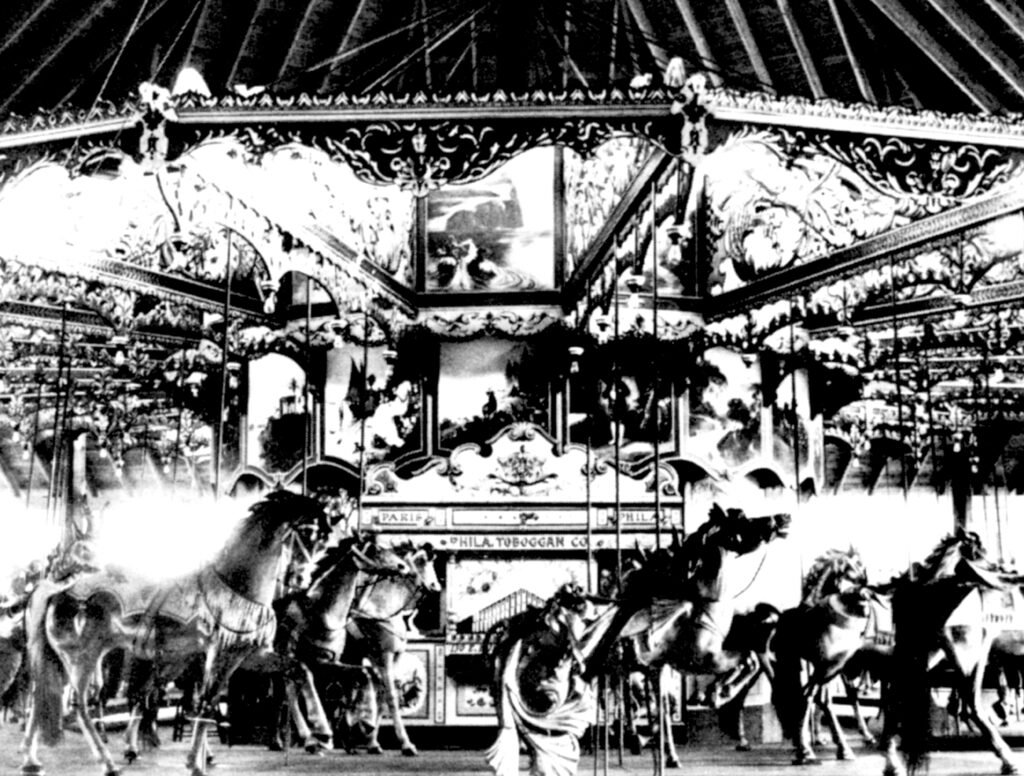
A hand-picked menagerie. PTC #6 has an unusually colorful origin story. At the time Elitch’s placed its order, the animals meant for the carousel were still on the factory floor alongside animals destined for the next two machines the company built, PTC #7 and #8. As the story goes, the Elitch Gardens agent didn’t simply accept a standard set — he hand-picked whichever carved animals he liked best from the shop floor, even ones intended for other machines. PTC carvers stamped the underside of each animal with its intended machine and row number, and to this day several of PTC #6’s figures still bear the numbers “7” or “8” on their undersides, evidence of this unconventional selection.
What it looked like. PTC #6 was a three-row, stationary (non-jumping) menagerie carousel with 46 hand-carved and hand-painted animals — no two alike — plus four ornate chariots. Alongside the customary horses rode a St. Bernard, a tiger, camels, giraffes, zebras, goats, deer, donkeys, a lion, and even a hippocampus, each animal dressed with its own carved flourishes (a snake, a mouse, a cherub, a sheik) worked into the saddle and trappings. The animals represented creatures from the Elitch Gardens Zoo. Two of the four chariots were intricately carved in red, while the other two were blue chariots painted to look carved. The whole assembly turned on a 45-foot platform at a brisk clip — reportedly more than 10 miles per hour. In 1909, a Wurlitzer 155 “Monster” military band organ was added to provide its music.
Why it left. By 1927, tastes had changed. Riders wanted “jumping” horses — animals that rise and fall as the carousel turns — and PTC #6’s animals were all stationary. Elitch’s decided the park needed a larger, more modern four-row machine, and ordered a new carousel from PTC. In 1928, the aging PTC #6 (along with its Wurlitzer band organ) was sold to Kit Carson County, Colorado, for $1,200, including delivery by train to the town of Burlington. The purchase proved controversial for the county commissioners who approved it: in the hard economic climate of the time, the “extravagant” spending on a used merry-go-round cost at least two of them their political careers.
Life after Elitch’s. The carousel spent about six years in storage during the Depression — reportedly even pressed into service as a grain silo, damaged by rodents, and at one point nearly ordered burned — before returning to operation in Burlington in 1937. Restoration of its band organ began in 1976, aided by a wave of Bicentennial-era community pride that led to the founding of the Kit Carson County Carousel Association. The carousel was placed on the National Register of Historic Places in 1978 and designated a National Historic Landmark in 1987, thanks in large part to a rare distinction: it is the only antique carousel in the country that retains its original paint on both its animals and its painted center core panels, and it is the only surviving PTC menagerie carousel. (In 1981, four of its animals were stolen and briefly used as, of all things, a grain-storage prop before being recovered from a Kansas warehouse and paraded triumphantly back into town.) Today, known as the Kit Carson County Carousel, it still operates seasonally in Burlington — the olde51st working carousel in Colorado.
Carousel #3: Philadelphia Toboggan Company #51 (PTC #51) (1928–Present)
Elitch’s replacement carousel, ordered from the same Philadelphia Toboggan Company, arrived for the 1928 season as PTC #51. Where PTC #6 had been stationary, PTC #51 was built for the new era of “jumping” carousels: overhead cranks drive 44 jumping horses, complemented by 18 standing horses and two ornate Roman-style chariots (pulled by their own jumping horses, not meant for riders), plus a pair of small standing horses from the Dentzel Company worked into the platform — 67 horses in all across four rows. Master carvers reportedly spent roughly three years hand-carving the figures, and the finished carousel cost about $52,000 to build.
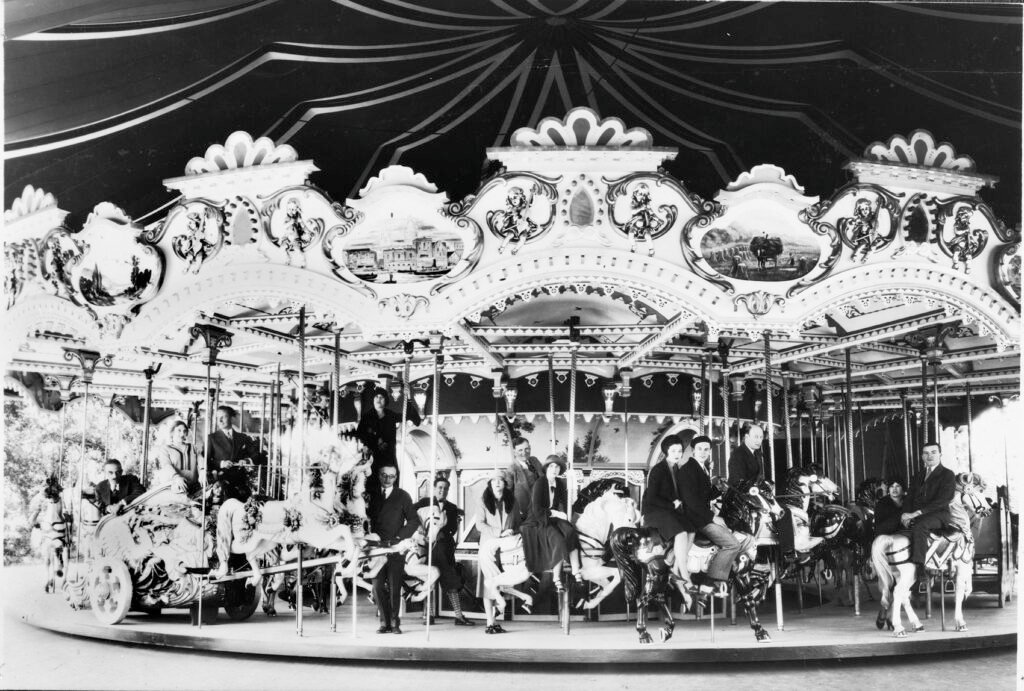
The chariots are especially elaborate, decorated with carved angels, cherubs, and figures of Miss Liberty with a bald eagle, and the rounding boards above the platform carry their own painted panels and cherub-and-shield motifs. Unlike PTC #6, this carousel has no band organ. PTC #51 was installed in a purpose-built pavilion — the Historic Elitch Carousel Dome — at the original park site at 38th Avenue and Tennyson Street, where it operated from 1928 until the park’s move in 1994–95. When Elitch Gardens relocated to its current downtown Denver site along the South Platte River, the carousel made the move too, becoming one of roughly fifteen original Elitch Gardens rides transplanted to the new location. It has operated there ever since, making it, remarkably, the same physical carousel Denver families have ridden for nearly a century. The old carousel dome building still stands at the original West Highland site, now used as a picnic pavilion within the Highlands’ Garden Village development, and is itself listed on the National Register of Historic Places.